
Tiny points of light
Stars flare and fade in the bleak NZ winter

A shameless plug!
A city, really, is a collection of stories, endlessly being rewritten. Without these personal dramas, there can be no city.
So, what better place to write about or from than Wellington — a capital city of words!

The Local community newspaper is hosting the Write Your Welly Life workshop on Sunday August 9, led by Dan Keane and using this very Substack as a case study. Nibbles, drinks and some useful exercises thrown in! Dan is a fearsomely good creative-writing teacher, and I’m delighted to be joining him.
I only wish I’d put on some slap before filming this, or brushed my hair, which has its own post-code. Don’t be put off.
Thank you for your attention to this matter.
You’re walking the dog between lopsided graves in Karori Cemetery. It’s a bit spooky, if you’re honest, with nobody around. The grassy paths feel spongy with recent rain. You need to step around snapped branches and avoid thick ribbons of mud.
The dog decides to evacuate on a medallion of lawn directly outside the Chapel of Remembrance, behind which is a discreet crematorium. Despite the raw cold, its front door is open, and you can’t stop yourself gazing at the coffin rollers, beyond which is a set of heavy crimson curtains. They’ve a satin finish and will close silkily around the coffin at the end of a service, sparing mourners any sight of the flues and dials of the charnel house.
A nasty realisation dawns as you stand there. These curtains look familiar. You’ve never liked them and have wanted to change them for ages, but the same ones are hanging at home.
YOUR HOUSE HAS CREMATORIUM CURTAINS!
A fantail loops around you, finding this hilarious.


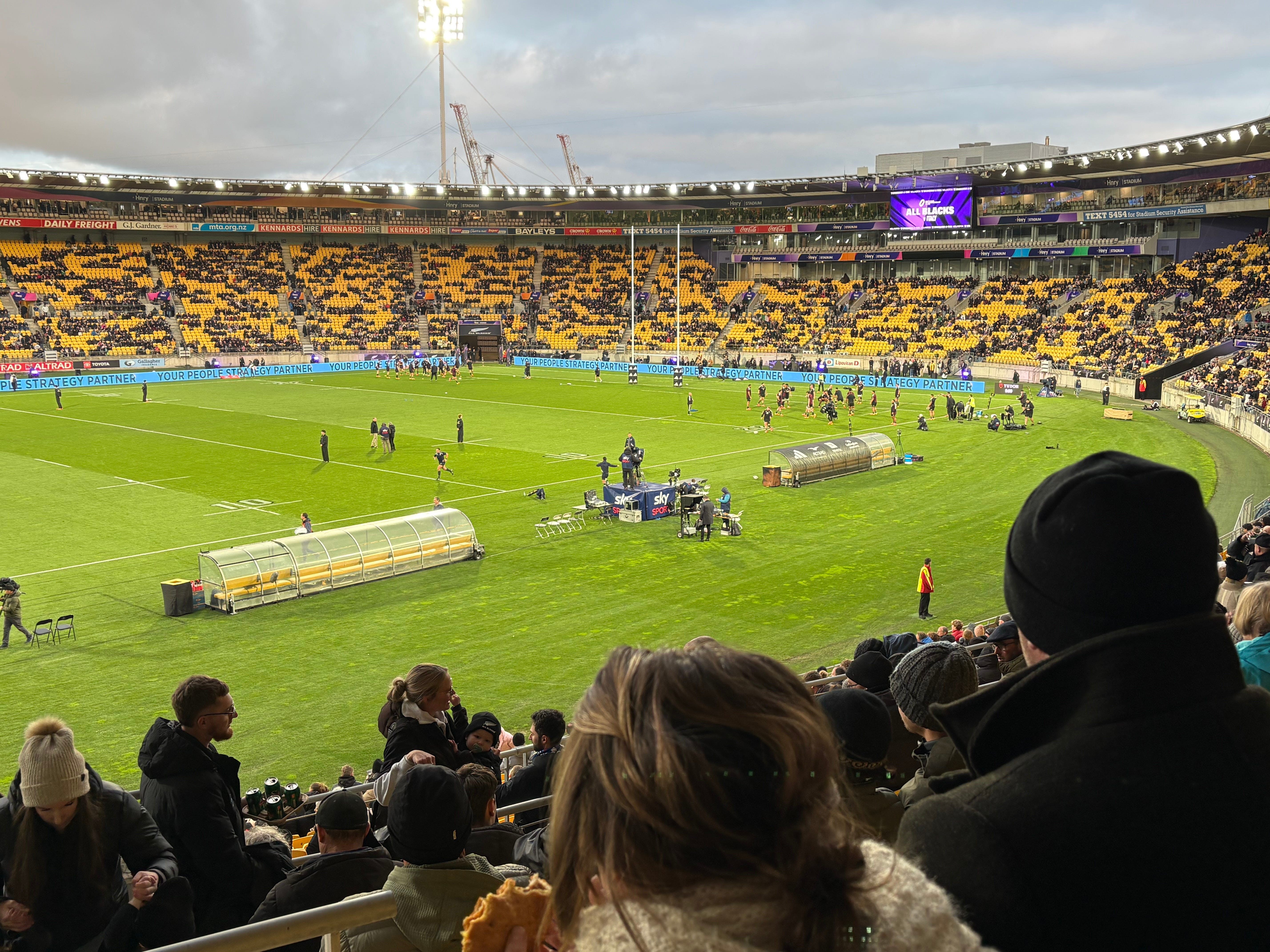
You’re in the stadium to watch the All Blacks play Italy. This information startles your friends, as it’s very off brand.
You’re wearing tights under your jeans and socks over the tights, a thermal vest beneath two jerseys, a thick scarf and a wool coat. You give your bobble hat to your son at halftime, by which time the skies are black, breathtaking cold has set in, and your undercarriage has gone numb.
Your section is hugely lively. Fellow fans feel strongly about each exchange of the ball, are opinionated about mistakes and exasperated by the ref. Language is fruity. Nobody seems to feel the cold, especially not the guy beside you, who has a trucker beard and is wearing denim shorts. He spends 80 minutes shouting at the team, but at some point, cheerfully tells you he forgot to bring his insulin.
Every ten minutes a rumble goes around the stadium — an incoming Mexican wave. You stand with both hands high and call, woo.
There are women your age everywhere, juggling babies, leading children in and out and ferrying hot chips along rows of family members. Middle-aged men nip frequently to the toilets and return with four-can trays of beer. A tiny boy near you holds up a hand-drawn sign that says BRING ON JOSH MOORBY. When this eventually happens, his father rolls it up and pockets it.
Every now and again there’s a snatch of Italian spoken in the stands. Perhaps they, too, are saying the F and C words, urging their boys to release the ball, pass the ball, keep it moving, that was knocked on, come on ref; it sounds vowel-rich and musical and smells, somehow, of basil.
You’ll surprise yourself when an All-Black dives across the line near your section, to score an audacious try. You’re on your feet ahead of your startled family, who actually follow the game and recognise the player, to scream your joy. You love all of it — the spider-cam whirring along the cables over the field, the burst of upright flames from the cannons, the young singer belting out bilingual pop at halftime to mark Matariki (you hold up your iPhone torch, adding your pinprick of light to hundreds of others in the stands).
It feels good on this freezing night to be a dot of light, inside an illuminated oval, at the centre of an island nation at the bottom of the world. Your elation will last beyond the final whistle, outside the stadium walls, despite the cruel wind sheeting off the harbour, tugging at your hair and scarf. As the crowd floods back to the city, you’ll grope for your teenager’s hand.
Sam Neill has died. The country is in shock.
The winter school holidays. It’s nastily cold, though the MetService app is annoyingly chipper about this (‘Right Now It’s 7°. Feels Like 3°’).
With the kids at home, that’s three times as much human breath in the house than is typical, and so you’ve spent the month fighting the prospect of mould. Releasing billows of steam from the kitchen, or from the bathroom after a teenager’s languorous shower, has become an obsession.
You spend your hours opening certain windows and closing others and wheeling the dehumidifier from room to room. You clean out the grate daily, tossing cold ash among the shrubbery. You screw up old bills and slice kindling, lighting the fire each afternoon. Your hair and clothes are sour with smoke.
Despite all this, you can almost feel the timber window frames swelling with rain. Spores inevitably speckle the glass. Low sun picks out all the details of your poor housekeeping: the dust clinging to the piano, thumbmarks on the TV. Dog chews stuffed under sofa cushions. Pans left to soak, wet knotted sheets in the dryer, squares of folded laundry uncollected on the table.
In winter especially, this house will not be tamed.
Texting about Sam Neill.
USHA: Why is the AUSTRALIAN prime minister making a comment about it?
YOU: Pavlova Syndrome.
You’ve been having variations on the same dream for months now. You’re fighting to get home to Taranaki, where your parents are waiting. Your Dad is still alive in this dream, the house shimmering on a green hill. In some dreams you’re hitching and in others, flying or taking a train. You’re desperate to get there, but somehow never do.
Dropping school blazers at the drycleaners. A police officer’s uniform hangs on the collection rack. It’s an almost childish blue, with stiff epaulettes and a row of silver buttons. There’s a peach ballgown nearby. Without people inside them these look comical, like stage costumes.
You’re sitting in a pharmacy consulting room, hidden from other shoppers by a panel of frosted glass. The pharmacist has snapped on disposable gloves and is parting your hair to examine your scalp. Yep: thanks to the cold and probably, stress, your psoriasis is back.
You’ll end up buying something medicated (Coco-Scalp! Developed by Dermatologists!) but for now, sit passively and experience the oddness of someone you barely know gently ruffling your hair. You feel grateful for the attention, honestly, and kindly towards her.
Beyond the glass, passport pictures are being posed and taken; prescriptions collected for children, parents and grandparents. Corn plasters, fungal creams, continence pads, compression socks pass across the counter, as well as hair nets, laxatives and threadworm tablets. How we shoppers itch, ooze, sneeze and sting and if very unlucky, tingle, in unspeakable places! What a business it is, staying alive!
You wouldn’t mind staying on this stool listening to ladies come and go, talking of impetigo. Life is nice behind this pane of frosted glass; it’s clinical in here, with charts on the wall whose lines and numbers don’t concern you. You’re exempted from the flow of life and although a decision will be expected from you shortly, it isn’t yet. The molecules around you settle and resettle, trying to work out if you’re a customer in this moment, or a patient.
Your daughter waits in the car, wondering where you went.
At last, you finish Land, Maggie O’Farrell’s latest novel. Exhausted, you let it drop to the rug beside the sofa. You seem to have spent weeks with this 19th century Irish family, a generation after the famine, cutting and burning turf with them, sloshing through bogs, listening to their fiddle, thatching their damned roof and putting pennies on the eyelids of their dead. And what thanks do you get?
Darlings! The workshop is on Sunday NINTH of August. My copy is now corrected
So beautifully written - I don't thank people enough for what they do to brighten our lives and reflect them back to us so well. Nga mihi, Leah