
Topics for French Conversation
Mon Dieu! I stabbed my husband!

It’s rubbish day. You open the curtains just as the recycling truck pulls up outside, painted with the slogan ONLY JUNK IN THE TRUNK.
This council tries too hard to be cute.
A Russian warship in the English Channel has fired a warning shot at a retired British couple bobbing in a yacht. Russia is claiming it was to avoid colliding in poor weather.
You’d like to comment ‘Fog, my ass’ under the article but can’t bring yourself to do so on The Times, a newspaper of record. You text it to friends instead.
You’re standing in the breezy doorway of the local mall, helping fundraise for the Scouts’ summer camp. The Scouts are in uniform holding labelled buckets, which they’re told not to shake. They may smile and make eye-contact with passing shoppers but may not ask directly for donations.
It’s a cold morning and more than once, you ask your fellow Scout if he’d like to move somewhere warmer, away from the drafts.
“Naw, I’m okay,” he replies. “I used to live in CANADA.”
For the most part, it’s the senior shoppers who appreciate a boy in a woggle and scarf, and they empty their coin purses into the buckets. People between 20 and 45 appear not to carry cash and rarely stop. About half of passers-by avoid eye-contact — mostly parents, whose kids are not Scouts. They’re in a hurry to get them to Saturday sport, and the world is heavy on their shoulders.
One man promises to come back when he has change, and he does. His wallet is plastered with charity stickers; he tells you he donates to causes as often as he can. The local barber leaves his shop and stuffs a generous donation into the nearest Scout’s bucket. After his scheduled hour comes to an end, your Scout has collected a very respectable thirty dollars.
You have two. One was donated by a passing friend and the other by your husband.
Your dog is outside and warbles for you, mournfully.
Your son’s account of his Year 9 health class continues to be the gift that keeps giving. At dinner, he says that this week the boys watched a video on Feelings. It featured an adolescent boy experiencing these, overlaid by a helpful narration.
“Yeah, so this kid meets a girl and then a voice goes, ‘At this moment, Daniel’s testes double in size,’ and that kind of stuff,” your son says, and stabs his butter chicken. It sent the boys into hysterics, and the teacher had to keep reminding them to focus.
You’re not sure how successful this was. They double in size? Really?
You’ve escaped for a couple of nights to Kāpiti, where your Mum’s house overlooks a small lake. It’s sludge-coloured early this morning, pocked by floating mats of lily pads. You stand in your Dad’s dressing gown with a coffee and watch an Australasian coot diving for grubs.
These coots are your least favourite of all the rails, having introduced themselves here with uniquely Aussie swagger. Their white bills are kind of flashy and you don’t like their harsh, pipping calls.
Your favourite rail is the pūkeko. They’ve much more of a New Zealand personality, being dorky, and startled all the time.
You drive to the local bookshop, Moby Dickens, to post a parcel for your Mum. As you slow for the lights you notice the driver beside you is curling her eyelashes in one of those clamps. She’s taken both hands off the wheel to do this and is staring into the mirror on her sun flap.
Perhaps drivers in small towns don’t need to take road rules seriously, as there’s barely any traffic to speak of. You could probably fry eggs on a ring on the dashboard in Paraparaumu, and who would care? Oncoming cars would have a good fifty metres to react.
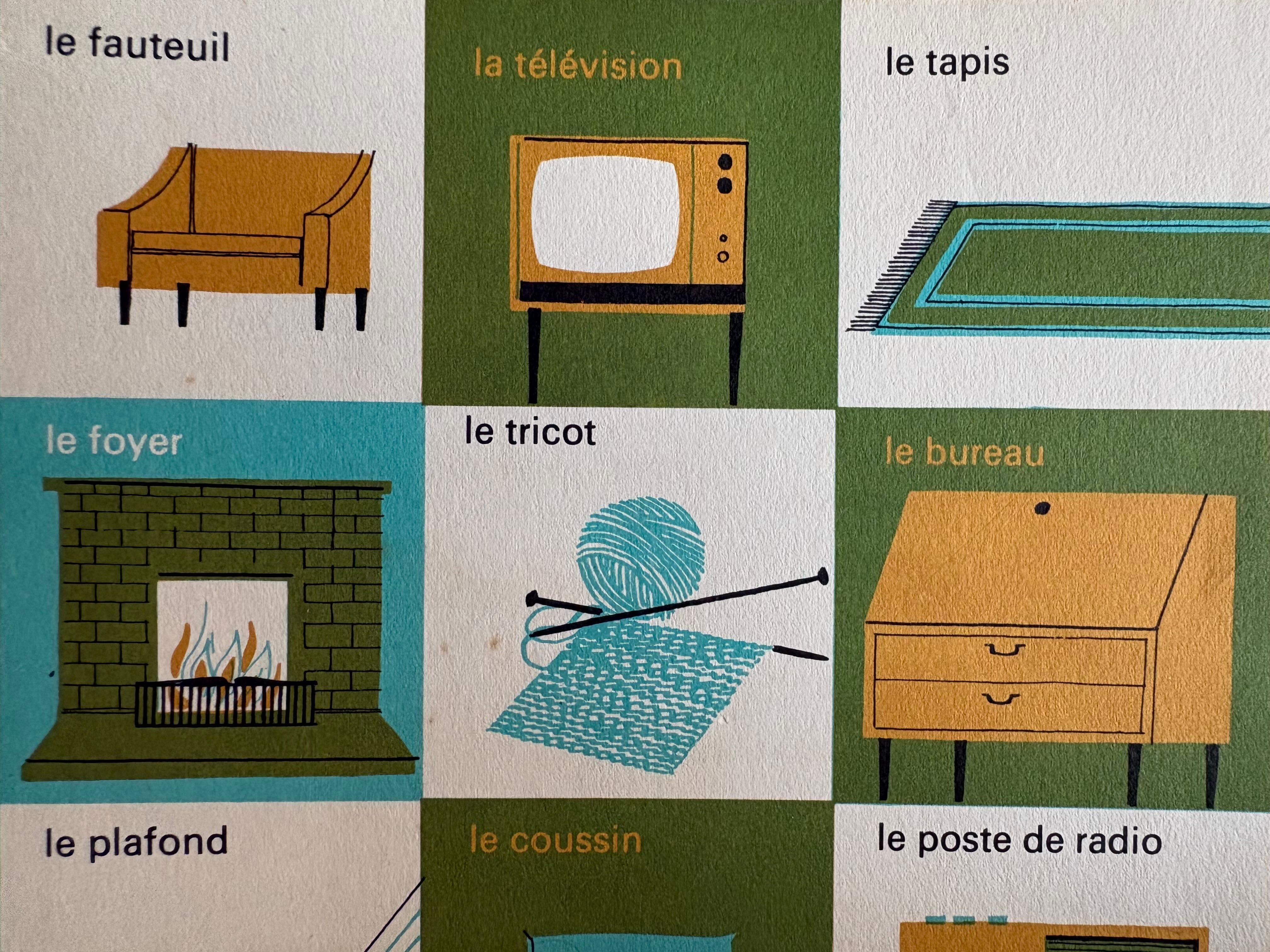
You need to brush up your French, to help your daughter practice. Your Mum digs around her shelf of foreign language books. She finds a vintage textbook that will do the trick, wedged between Pitman Shorthand and German Means Business.
It features a mid-century nuclear family going about its conformist affairs, mostly in the home. The whole thing is a feminist nightmare featuring exactly the conditions that sent women off the deep end in the Seventies, sitting in consciousness-raising circles with Gloria Steinem and refusing to cook tea.
The interiors, though, are fantastic.
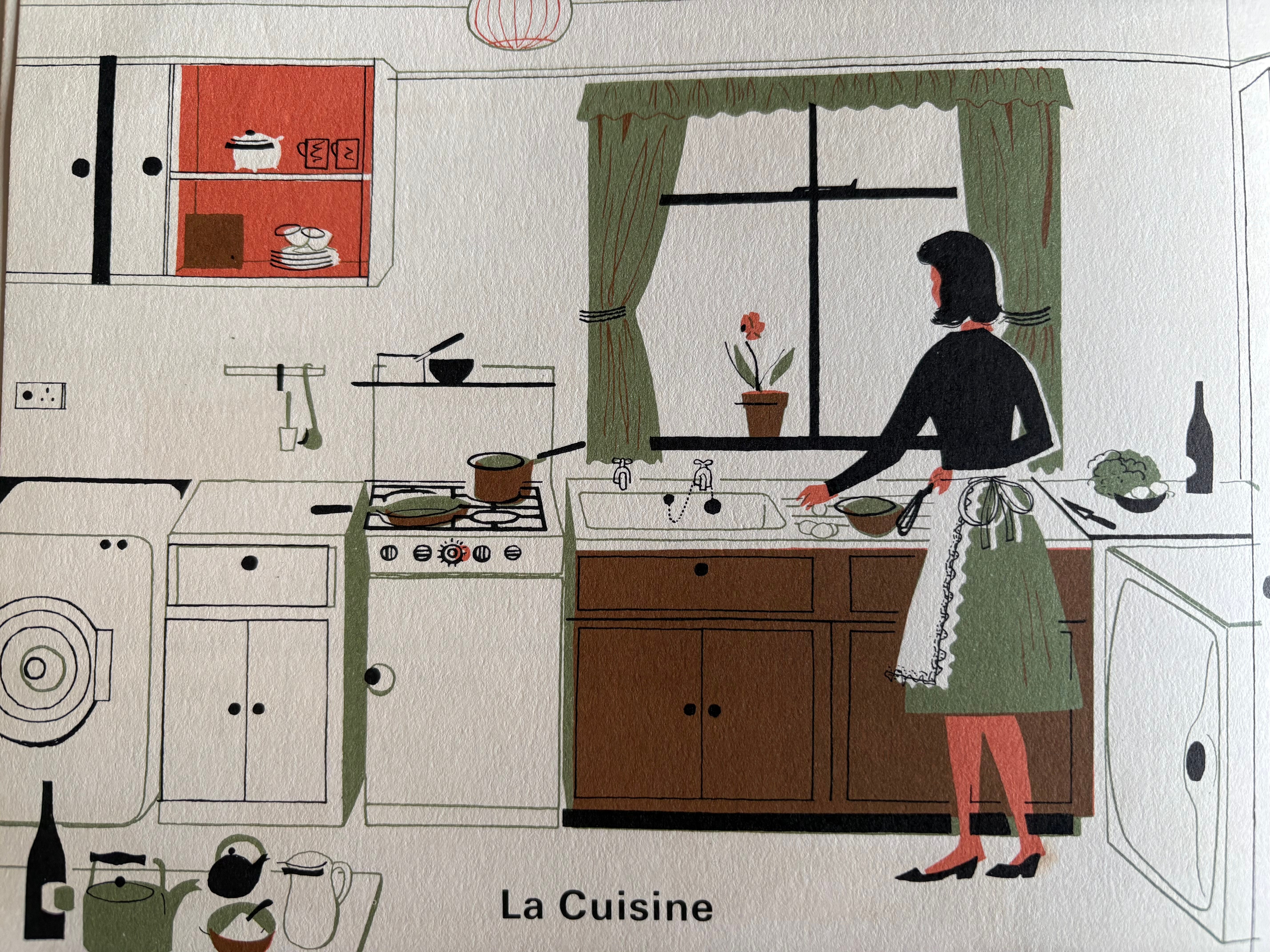
↓ Here’s Maman in a frilled half-apron. Let’s hope she doesn’t leave the gas on!
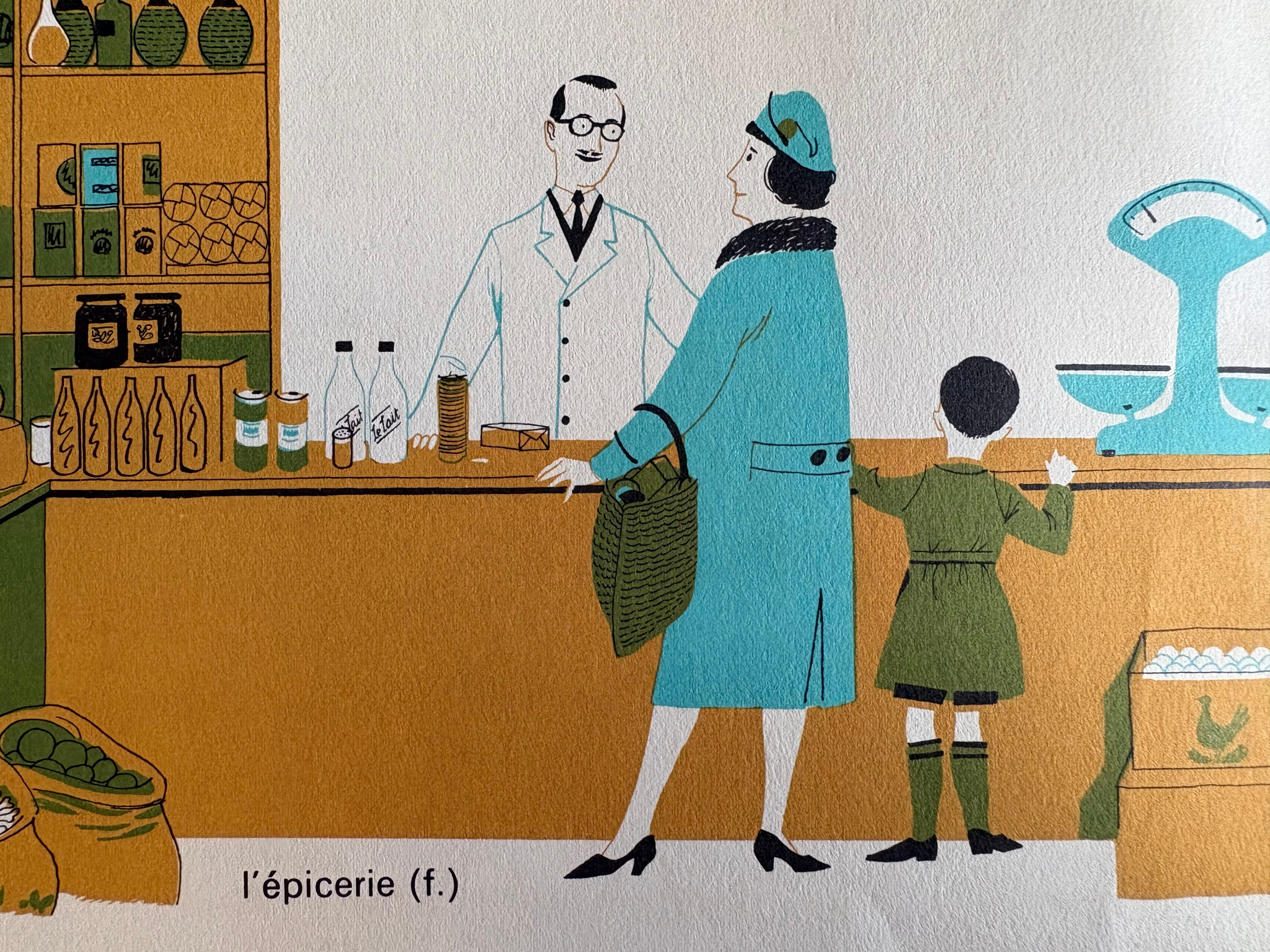
↓ Grandmère is at the grocer, while minding little Henri for the day. She’s asking for a bottle of sherry, the cheaper the better. She doesn’t plan to cook with it.
↓ Papa lit son journal (the business section). Maman knits for a baby, as she’s up the spout again. Henri joue avec son avion, as he plans to be a pilot, and Marie s’amuse avec sa poupée. She’ll grow up to be an air hostess, providing she’s pretty enough!
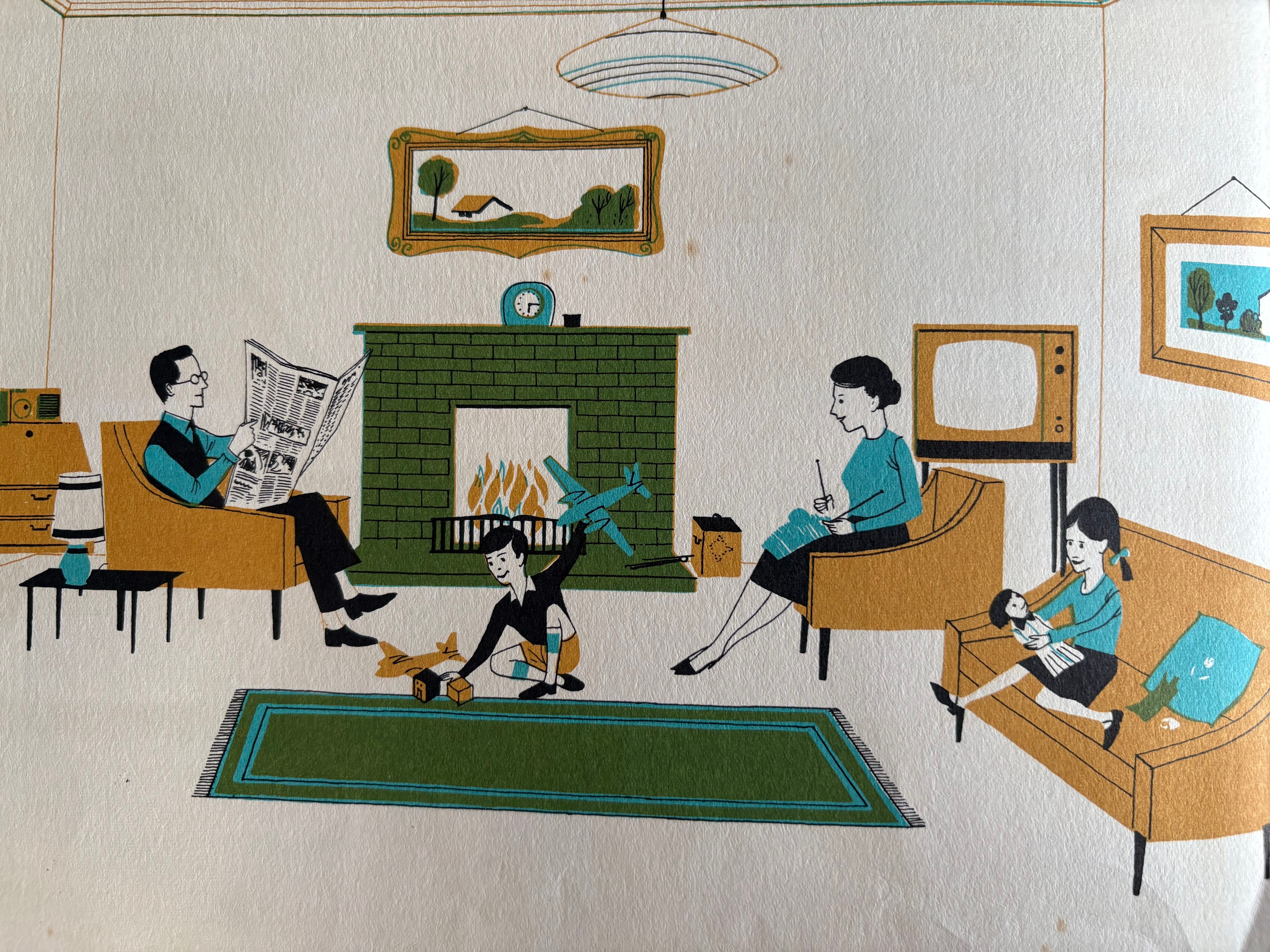
You want to climb into these domestic scenes for a moment and experience a vanished world of transistor radios, cabinet TVs, pipes and slippers. Imagine sitting in your living room every evening in low heels with your ankles neatly crossed, just in case your oblivious husband notices you live there. How chic! How pointless! How French!
She’s gripping those needles a little tightly, isn’t she?
Pauvre Papa! Il a été assassiné!
You’re gift-shopping for a newborn. It’s been thirteen years since you last needed baby things and the selection hasn’t really moved on, because how do you improve on a bib? Still, it’s difficult to choose, as there are so many products it would be presumptuous to buy.
You avoid the feeding section, because it’s a minefield. Nor can you wade into the great nappy debate. Buy washables, and you’re imposing your environmentalism on this family. Buy disposables and you might as well drill for oil in their front garden.
Similarly, dummies. There are schools of thought for and against; you remember browsing the cheese chiller at the Island Bay New World and a stranger reaching across your trolley to pluck one from your infant’s mouth. “I don’t like to see that,” this woman said briskly, leaving you and your baby slack-jawed with surprise.
Sometimes it’s nice to buy for the mother, rather than the baby, but not nipple cream. This would imply you’ve imagined her breasts. A donut-shaped perineal cushion with cold gel inserts, while a welcome relief, is also too intimate a choice. One’s haemorrhoids are between a woman and her doctor and should never see the light of day.
You buy a six-pack of facecloths and a hooded towel.
Your Mum says the local chemist is testing a robot. Presumably it frees up the pharmacists to do the job they were trained for: murmuring to customers about their erectile dysfunction, or corns.
You wish to see this marvel for yourself, so pop in after posting the parcel. Things have definitely changed in the store. Pharmacists are bashing away on laptops, fulfilling prescriptions while the robotics take place behind a false wall.
“Is it true there’s a robot back there?” you ask a staff member. She says yes. There are shelves of controlled medications inside a purpose-built internal room, and the robot retrieves them on demand, placing them on a conveyor which scootches the package to the relevant pharmacist.
“It has an arm,” she tells you, performing a reaching gesture.
The robot doesn’t appear to have taken anybody’s job. You’ve never seen so many pharmacists in one place, because they’ve all come out of the back room and are in full view of the shoppers. In some ways the store is now like a party, full of buzz, light and purpose, except nobody’s waving around a chicken skewer and arguing about politics.
On the drive home you pass a rubbish truck extending its mechanical claw around a wheelie bin.
You’re in the line at the dairy for milk. The shopper ahead of you is crestfallen to be told her items add up to $16.
“I’m going to need to fetch my husband,” she says, inching towards the door, “as I don’t have any big money. Only small money.”
If that isn’t the most New Zealand statement you’ve ever heard, you don’t know what is.
*About the pictures
All images from Topics for French Conversation by Colin Henstock, illustrated by John C Gardner (Blackie & Son, 1966). Glasgow’s ‘Blackies’ was shuttered in 1991 and its books are now highly collectable. I’m gagging to find their 1960 edition, Marie Curie, also illustrated by Gardner, who must’ve found it a nice change to draw a scientist in a lady’s body.
Qu’est-ce que tu fais ce weekend?
Hello to new readers, and welcome to Karori (one road in, one road out)! I must thank Simon Wilson of Hopetown for recommending me to his subscribers, who rather dazzle, I have to tell you. Much like he does.
I’m still up the coast north of Wellington but drive home tomorrow. I’m meeting my oldest mates for dinner and a show. We’re off to watch Shayne P Carter on outrageous guitar, performing an orchestrated selection from his songbook with the NZSO.
I love the Michael Fowler Centre and its maple-syrup panelling. I’ve no idea where we’re sitting but hope I can see clearly other friends of this blog on stage: Section Principal Second Violin Andrew Thomson and fellow Karorian Kirstin Eade (Associate Principal, Flute), as well as my old mate Larry on timps (Section Principal Timpani, Laurence Reese).
My time as NZSO publicist left a forever impression on me. Every day there was an emotional one, with music literally vibrating the air and the halls. I felt terribly strongly about the orchestra as a world class band which also appeared an underdog — a delicious proposition for any publicist. I have an enormous, lasting crush on it.
If you’re in Wellington, why not go to the gig, as there are tickets still available? But don’t sit behind me, as my hair is absolutely huge at the moment.
Speaking of hair, I’m shameless in the upcoming issue of the Listener, but we ignore the haircuts of public figures at our peril.
Look at Greta Thunberg, the Shirley Temple of the activist left. Didn’t we all love her when she had pigtails? Those school strikes were so darned cute. Now she has a bob and fringe and is a danger to international shipping.
It’s on sale from Monday, fellow New Zealanders!
Please do click the heart, so other readers can find us. Bisou bisou! 💋
Beacoup de LOLS merci xx
You’re hilarious and adorable. My Grammy learned to write in shorthand and it’s always fascinating to me.